
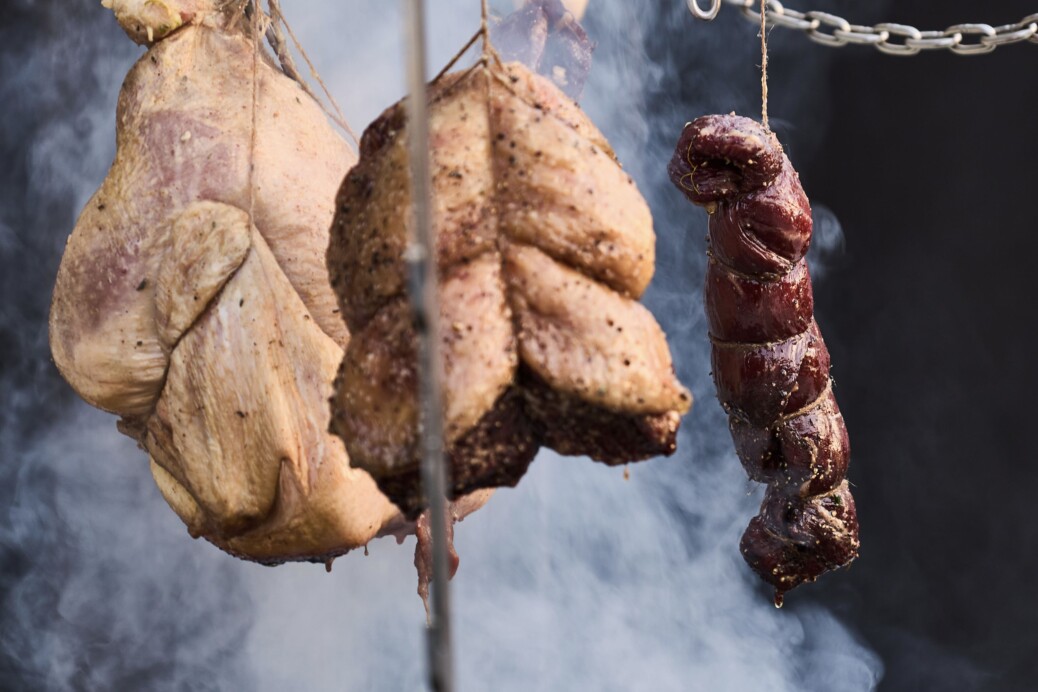
Smoke is often treated as a shortcut to flavor, when in reality, it is one of the most misused and misunderstood elements in live fire cooking.
When applied with knowledge and restraint, smoke adds depth, aroma, and complexity that no other technique can replicate. When applied indiscriminately, it overwhelms food, masks flaws, and leaves bitterness behind.
Understanding smoke is not about adding more of it: It is about knowing when it helps … and when it harms.
What is Smoke?
Smoke is a byproduct of combustion and its quality depends entirely on how fire is managed.
Different combustion states produce radically different smoke profiles:
- Clean combustion produces light, aromatic compounds
- Incomplete combustion produces harsh, bitter residues
- Smoldering produces heavy particulates that cling aggressively
The flavor outcome is determined long before food ever touches the grill, which is why experienced cooks pay more attention to the fire than to the food during the smoking phase.
One of the most important distinctions is the difference between clean smoke and dirty smoke. Color, density, and smell are immediate indicators: If smoke stings the eyes or smells sharp, it will taste worse on the plate.
Clean Smoke
- Thin, light, often barely visible
- Mild, sweet, aromatic
- Indicates efficient combustion
This smoke enhances food without dominating it.
Dirty Smoke
- Thick, white, or grey
- Acrid, bitter, lingering
- Indicates incomplete combustion
This smoke coats food with unpleasant compounds that cannot be removed.
The Chemistry Behind Smoke
“Smoke flavor” comes from a complex mix of volatile compounds released as wood breaks down under heat. These include phenols, aldehydes, and organic acids, each contributing different aromatic qualities.
However, these compounds are beneficial only within very narrow ranges.
Too little smoke contributes nothing.
Too much smoke overwhelms taste and masks texture.
Balance is achieved not by volume, but by exposure time and combustion quality.
This is why lightly smoked food often tastes richer than heavily smoked food.
Wood Choice Matters less than Combustion
Cooks often obsess over wood species while ignoring fire behavior.
Yes, different woods contribute different aromatic notes:
- Fruit woods tend to be lighter and sweeter
- Hardwoods tend to be stronger and more assertive
But even the best wood produces bad smoke if burned poorly.
Wet wood, insufficient airflow, or smoldering logs generate bitterness regardless of species. Dry, properly ignited wood burned with oxygen produces clean, usable smoke.
Wood choice refines flavor but fire management determines whether that flavor is pleasant at all.
Smoke Is Not Constant
Smoke should not be present throughout the entire cook: Most foods benefit from smoke exposure early, when surfaces are moist and receptive. As cooking progresses and surfaces dry, smoke absorption decreases and bitterness risk increases.
Skilled cooks know when to:
- Introduce smoke
- Reduce it
- Eliminate it entirely
Continuous smoke is rarely necessary and often harmful.
Restraint Is the Mark of Skill
Heavy smoke is often used to compensate for:
- Poor seasoning
- Inconsistent heat
- Lack of technique
This approach may impress visually, but it reveals insecurity rather than mastery.
Restraint allows:
- Ingredients to remain recognizable
- Fire to support rather than dominate
- Flavor to develop in layers
In live fire cooking, less smoke is usually more confidence.
The Smoke Ring: Signal, Not Proof
Few visual elements in BBQ are as misunderstood as the smoke ring.
Often treated as a badge of honor or proof of mastery, the smoke ring is not a measure of flavor, doneness, or technical excellence. It is a chemical reaction, and understanding it helps demystify one of live fire cooking’s most persistent myths.
The smoke ring forms when nitric oxide (NO) and carbon monoxide (CO) produced during combustion interact with myoglobin in meat before it fully denatures. These gases prevent myoglobin from turning brown, leaving a pink or red layer beneath the surface, even though the meat is fully cooked.
What the Smoke Ring Tells You … and What it Doesn’t
A visible smoke ring indicates that:
- Combustion gases were present early in the cook
- The meat surface was cool and moist enough to absorb them
- The fire produced certain byproducts under specific conditions
It does not indicate:
- Proper seasoning
- Balanced smoke flavor
- Correct doneness
- Skillful fire management overall
It is entirely possible to produce:
- Excellent flavor with no smoke ring
- A dramatic smoke ring with bitter, over-smoked meat
The two are not directly correlated. In other words, the smoke ring is an indicator of timing and chemistry, not taste.
Why Chasing the Smoke Ring Is a Mistake
Because the smoke ring is visually striking, many cooks attempt to force it, often by:
- Over-smoking early
- Using specific fuels for appearance
- Manipulating moisture unnaturally
These tactics prioritize appearance over eating quality and often result in food that looks impressive but tastes unbalanced.
Experienced cooks focus instead on:
- Clean combustion
- Controlled exposure
- Proper heat management
If a smoke ring appears naturally, it is incidental, not intentional.
The Competition Perspective
In disciplined competitions, the smoke ring is not a scoring criterion.
Judges evaluate:
- Flavor balance
- Texture and doneness
- Clarity of smoke integration
- Overall execution
A smoke ring may be present. It may not. Either way, it carries no weight unless it contributes positively to the eating experience (which it rarely does on its own).
This distinction reinforces a broader principle of live fire cooking:
What matters is what you taste, not what you see.
In structured competitions, smoke misuse is one of the most common reasons dishes lose points. Over-smoked food tastes flat, one-dimensional, or even worse: bitter. Proper smoke use enhances rather than announces itself.
This reinforces an important principle:
If smoke is the first thing noticed, it is already too much.
The smoke ring is best understood as a manifestation of process, not a validation of skill. It reflects conditions at a specific moment early in cooking, nothing more.
True mastery of smoke is evident in:
- Subtle aroma
- Clean finish
- Ingredients that remain identifiable
- Absence of bitterness or ashiness
Smoke is a contributor to flavor. Used with care, it deepens food without obscuring it. Used carelessly, it destroys balance and credibility. In live fire cooking, mastery is not measured by how much smoke you create but by how little you need.
