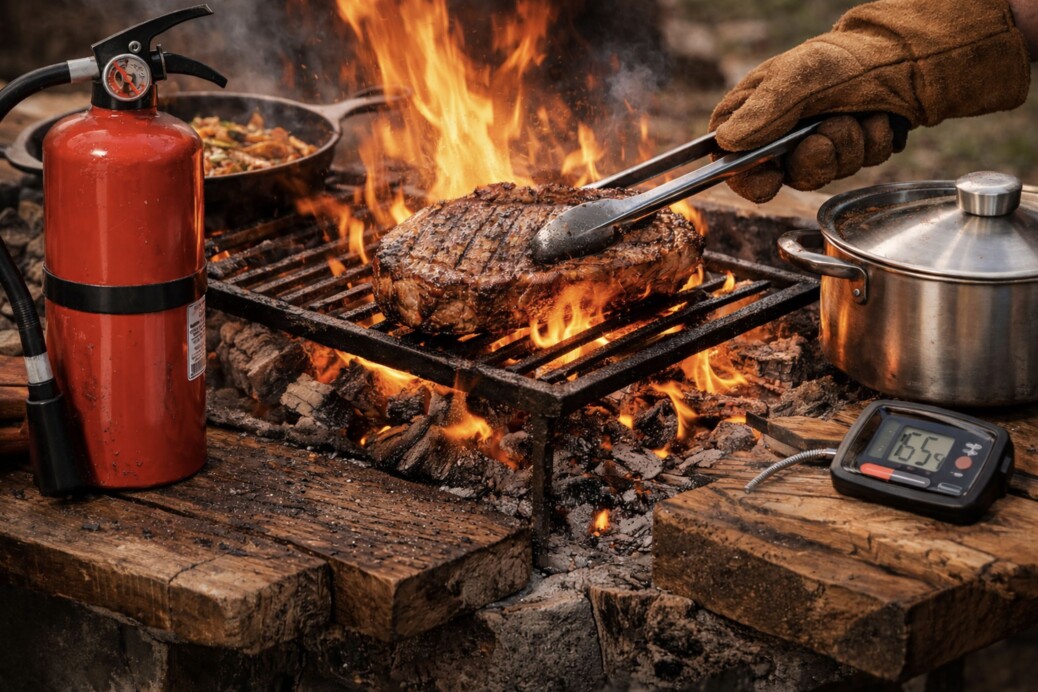
Live fire cooking is unforgiving. Fire does not negotiate. When treated casually, it can become dangerous – to cooks, to guests, and to the credibility of the craft itself. But when treated with discipline, it becomes one of the most precise and expressive tools in cooking. Safety is not a constraint on creativity: It is the foundation that makes serious live fire cooking possible.
Fire Demands Discipline, Not Fear
Safety in live fire cooking is often misunderstood as caution driven by fear. In reality, it is the opposite.
Experienced fire cooks are not fearful: they are prepared. They understand how fire behaves, where risk accumulates, and how to prevent small problems from becoming dangerous ones.
Discipline replaces anxiety.
Preparation replaces reaction.
This mindset is what separates professionals from improvisers.
Fire Is a System, Not a Moment
Accidents rarely come from a single mistake. They come from systems that were never designed.
Fire safety begins before ignition:
- Is the cooking area stable and level?
- Are fuels stored away from heat?
- Is airflow controlled and predictable?
- Is there space to move without rushing?
A well-designed fire setup anticipates movement, fatigue, distractions, and changing conditions. A poorly designed one relies on luck, and luck is not a strategy.
Clothing, Tools, and Personal Responsibility
Live fire cooking exposes the body to radiant heat, sparks, and hot surfaces. This demands intentional choices.
Responsible cooks:
- Wear natural fibers that resist melting
- Avoid loose clothing that can catch flame
- Use tools long enough to maintain distance
- Know exactly where hot objects are placed
Protective behavior is not overkill. It is respect – for oneself and for those nearby.
Managing Crowds and Shared Spaces
Fire risk multiplies in the presence of others.
Public events, competitions, and group cooks introduce:
- Unpredictable movement
- Distraction
- Reduced reaction time
In these environments, discipline must increase, not relax. Clear boundaries, controlled access to fire zones, and defined roles are essential. Fire should never be left unattended, assumed safe, or treated as a spectacle for proximity.
If people do not know where to stand, the setup has already failed.
Fuel, Fat, and the Reality of Flare-Ups
Many incidents in live fire cooking are not caused by flame but by fat interacting with fire.
Uncontrolled flare-ups result from:
- Excess fat dripping onto open flame
- Cooking too close to fresh fuel
- Poor heat zoning
Experienced cooks anticipate this behavior. They render deliberately, position food intelligently, and allow flare-ups to subside naturally rather than reacting with panic.
Fire discipline is knowing when not to intervene.
Extinguishing is Part of Cooking
Every live fire cook should know:
- How to safely reduce heat
- How to isolate fuel
- When to let fire burn out naturally
- When intervention is required
Fire extinguishers, sand, and water all have roles, but misuse can worsen a situation. Knowing how to extinguish is as important as knowing when.
Preparedness is silent until it is needed. Then it matters more than anything else.
Safety is not Optional
Fire accidents do more than injure people. They damage trust, close venues, and set the craft back.
When live fire cooking is treated irresponsibly, it invites restriction, regulation, and removal from public spaces. Safety is therefore not just personal but rather a collective responsibility.
For the Middle East Live Fire Cooking Society, this is also an ethical stance:
- We protect participants and guests
- We safeguard venues and partners
- We preserve the legitimacy of live fire cooking
Fire Discipline is not a footnote, it is a prerequisite that keeps the door open for the future.
By treating safety as an integral part of craft, we reinforces a culture where fire is understood and respected, but not feared, and never trivialized.
Safety in live fire cooking is the condition that allows skill to exist.
